Everyone has AI. Why doesn't the company learn?
AI summary
- The first thing AI makes cheap is not wisdom. It makes drafts cheap: meeting summaries, plans, reviews, support replies, analysis notes, code, and plausible-looking answers.
- A company does not learn because more of those artifacts exist. It learns only when yesterday's work changes tomorrow's workflow.
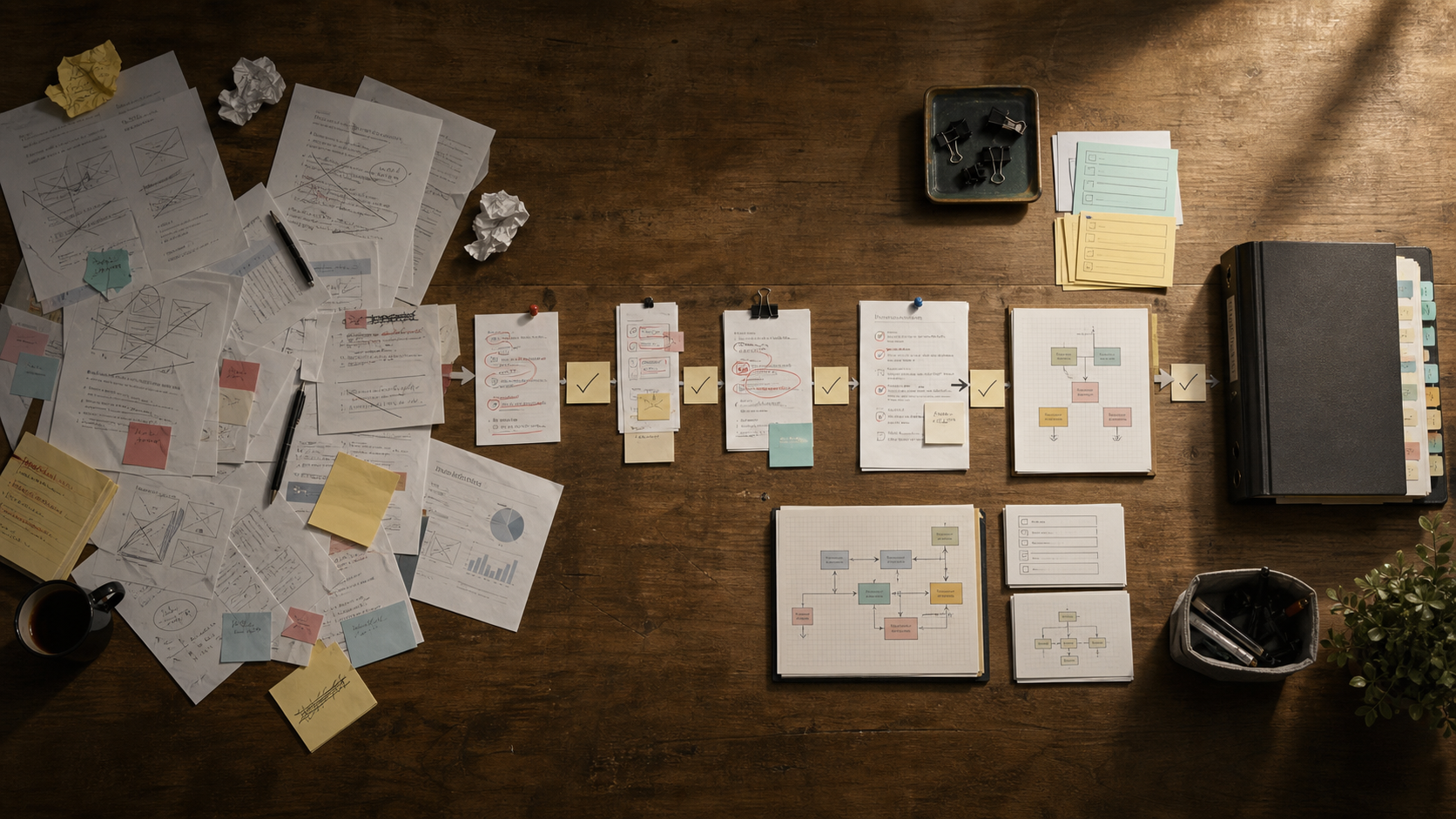
- The useful distinction is output, experience, and institutional memory. Output is a document. Experience is why the document was right or wrong. Institutional memory is the checklist, agent, workflow, rule, test, or decision record that lets another person reuse that experience later.
- The best enterprise cases are not "everyone has a chatbot." They are narrow loops where approved judgment gets built into the work itself: legal checks, payment validation, product planning, support triage, code review.
- The danger is not that AI fails to summarize. It is that AI summarizes so well that a company mistakes more finished-looking work for actual learning.
The first thing that changes inside a company using AI is not the quality of its decisions. It is the volume of middle drafts.
Before the product review, there are three competitor scans instead of one. After the customer call, there are five versions of the account summary. Before launch, there is a risk list, a mitigation list, a user-message draft, a release-note draft, and a fallback plan. A manager asks for a one-page view at 5:40 pm and gets something polished enough by dinner.
At first this feels like progress. The organization reacts faster. Fewer blank pages survive the afternoon. People who used to wait for an analyst, a PM, a lawyer, or a senior engineer can at least get a first pass on the table.
Then two weeks pass.
Why did we choose this price? Which assumption in that launch plan turned out false? Did the risk list become part of the release checklist? Did the customer objection that came up ten times make it into the onboarding flow? Can the next team reuse the hard-won review comment, or is it still trapped in one pull request?
Often the answer is worse than anyone wants to admit. The work was done. The company did not learn.
That is the first serious divide in enterprise AI. AI makes it easier to finish a piece of work. It does not, by itself, make the organization better at the next similar piece of work.
Output is not memory
One useful way to keep the problem straight is to separate three things that get blurred together.
Output is the thing AI is good at making cheap: a summary, a draft, a plan, a pull request, a table, a response.
Experience is what happened when that output met reality: which facts mattered, which assumption broke, what the reviewer objected to, what the customer still did not understand, what the production incident taught the team.
Institutional memory is experience that has been made reusable: a checklist, a decision record, a test case, a playbook, a workflow, an internal agent, an escalation rule, a data model, a permission boundary.
Most companies are buying output. Some are accumulating experience. Very few are disciplined about turning experience into memory.
That distinction is the difference between a company that owns AI licenses and a company that learns with AI.
Microsoft's 2026 Work Trend Index gives the idea a name: a firm has to become a "Learning System." The report's most useful line is not a prediction about agents. It is the diagnosis that people are often ready while the systems around them are not. Microsoft also found that organizational factors like culture, manager support, and talent practices account for more of AI's reported impact than individual behavior alone.
Put more plainly: the person at the keyboard is no longer the whole story. The work system around that person decides whether their better draft becomes a better company.
The meeting note trap
Start with the smallest example: meeting notes.
AI meeting summaries are good enough now that many teams treat them as solved plumbing. A call ends. The transcript becomes bullets. Action items get names. Decisions are marked. Risks are extracted. Everyone nods. The summary is posted into chat.
Then nothing structural happens.
The action item is not linked to the project tracker. The decision is not added to a decision log. The unresolved disagreement is not carried into the next review. The risk is not converted into a launch checklist item. The customer phrase that explained the whole problem is not added to the research repository. The same group meets again later and rediscovers the same uncertainty with fresher phrasing.
The note was useful. It was not memory.
A team that learns treats the summary as raw material, not the final artifact. It asks a few boring questions after the meeting:
What changed because of this meeting?
Which future workflow should now be different?
What should be impossible to forget next time?
Those questions matter because AI has made "writing it down" cheap. But organizational learning was never the act of writing something down. It was the act of making future work behave differently.
Customer support is a listening system, or it is just deflection
Customer support is one of the easiest places to see the difference.
A support AI that answers questions faster is automation. That may be valuable. It may reduce cost. It may improve wait times. But if the system stops there, it has only made the front line quieter.
A learning organization uses support as a sensor.
If an AI agent answers the same billing question ten thousand times, the most interesting artifact is not the ten-thousandth answer. It is the pattern underneath: which policy is unclear, which screen is misleading, which product behavior creates the confusion, which help article has the wrong example, which account state keeps producing avoidable tickets.
That information belongs upstream. Product should see it. Docs should see it. Finance ops should see it. The onboarding flow should change. The next version of the support agent should carry the new answer because the company fixed the source of the question, not because the model got better at politely repeating the old explanation.
OpenAI's enterprise report includes Lowe's as a concrete version of this pattern. Lowe's deployed Mylow for online shoppers and Mylow Companion for associates across stores, answering questions about product specs, project know-how, and order status. The interesting part is not simply that a model answers nearly a million questions a month. It is that expertise once scattered across stores, product catalogs, and experienced associates becomes a more consistent operating surface for customers and new staff.
The hard version of the same idea is not "AI support." It is a company asking: what are our customers teaching us every day that we keep burying as closed tickets?
Code review should become a constraint, not a ritual
Software teams are living through the same shift.
AI coding tools make it easy to produce more code. That is not automatically good. A team can get faster at generating pull requests while getting slower at understanding the system. Review queues grow. Test gaps multiply. The same architecture comment appears for the ninth time in a month. A senior engineer writes another careful paragraph explaining why this module should not call that service directly.
If the paragraph dies inside the pull request, the organization paid for the lesson once and failed to buy it.
A learning engineering organization looks for repeat criticism. If reviewers keep saying "this path needs an idempotency key," that becomes a test helper, a lint rule, a template, or a framework boundary. If production incidents keep tracing back to missing timeouts, timeout policy becomes part of the client library. If AI-generated code keeps making the same unsafe migration, the migration generator changes and the review checklist becomes stricter.
The point is not to replace judgment with rules. The point is to stop spending human judgment on the same preventable mistake forever.
This is where AI can either help or make the mess worse. A code assistant can write another implementation. Better, it can help turn yesterday's review into tomorrow's guardrail: generate the failing test, draft the lint rule, update the internal template, summarize the architectural rule in the repository guide, and check future changes against it.
That is organizational learning in a very practical form. The company did not just ship one more pull request. It removed one class of future pull request debate.
Legal judgment is valuable because it is reviewed
The cleanest enterprise AI examples are often less glamorous than demos. They are narrow, reviewed, and slightly dull.
BBVA's legal chatbot in Mexico is a good example. The bank has to check whether a company representative has legal authority to sign before certain transactions can proceed. That work used to rely on a specialist legal team answering repetitive branch questions. BBVA built a generative AI chatbot around standardized, pre-validated legal FAQs and documentation guidance reviewed by its Legal Services team. OpenAI reports that the system automates more than 9,000 queries annually and frees the equivalent of three full-time roles for higher-value legal work.
The important word there is not "chatbot." It is "pre-validated."
Legal work is a good test of whether a company understands AI because the cost of a wrong answer is obvious. Nobody should want a model freelancing on signatory authority. The useful thing is not creativity. It is getting reviewed judgment to the branch at the moment work would otherwise stall.
That is the pattern worth generalizing.
AI is best at organizational learning when it carries approved judgment into the workflow:
The policy that has already been checked.
The exception path that has already been agreed.
The risk classification that has already been argued through.
The contract redline that has already survived legal review.
In that form, AI is not a clever intern. It is a distribution mechanism for institutional judgment.
The rejected option is often the memory
Product work exposes a subtler failure.
AI makes product teams much better at producing options. A PM can generate five pricing schemes, three onboarding flows, a competitive landscape, a release plan, and a risk table before the second coffee. Some of it will be useful. Much of it will be plausible.
The danger is that plausible options make forgetting cheaper too.
When the team chooses option A over option B, the real learning is often not the final slide. It is the reason B lost. Maybe B looked better for activation but would have made enterprise procurement harder. Maybe B solved the new-user problem by confusing existing users. Maybe B was attractive until support showed that the edge case was not an edge case.
If that reasoning is not saved, the organization remembers only the conclusion. Three months later a new team rediscovers option B and pays the same argument again.
This is one reason decision records matter more in the AI era, not less. When generation is cheap, the number of plausible paths explodes. The scarce resource becomes memory of why certain paths were closed.
A good AI workflow for product planning should not only draft the plan. It should preserve the graveyard:
What did we consider?
Why did we reject it?
What evidence would make us reopen it?
Who owns the risk if the chosen path is wrong?
That is less glamorous than a generated strategy document. It is also much more valuable six months later.
Mature use looks less magical
The best official case studies share an unromantic quality. They do not describe AI as a general mist sprayed over the company. They describe narrow loops.
At BNY, Microsoft describes "digital employees" with supervisors, credentials, review processes, and tight scopes. One payment-validation agent reads a vendor address, calls a mapping API, checks the country code, and submits the correction for human review. The scope is narrow because the bank moves enormous sums and needs every AI path to be observable and auditable. In that setting, trust comes from constraint, not from broad autonomy.
At Moderna, OpenAI describes AI helping with Target Product Profile work: teams reviewing large evidence packs, extracting facts and assumptions, drafting structured sections, and flagging possible errors for human oversight. The interesting move is not that AI writes a document faster. It is that a multi-week cross-functional knowledge process starts becoming a repeatable workflow with clearer intermediate artifacts.
These are not science-fiction stories. They are office stories. A payment field gets checked. A legal answer reaches a branch. A product profile absorbs evidence faster. A store associate answers a customer with more consistent expertise.
That is why they matter.
Enterprise AI becomes real when it stops being a separate magic box and starts changing the ordinary path of work: where a question enters, which facts are pulled, who reviews the answer, what gets logged, what becomes a rule, what gets improved next time.
More AI can also mean faster forgetting
There is a darker version of the same story.
NBER working paper 34910, AI, Human Cognition and Knowledge Collapse, models a tension that is easy to feel in daily work. Agentic AI can improve immediate decision quality. But if people stop doing the learning work that produces shared general knowledge, the long-run stock of collective knowledge can erode. Better personalized advice in the moment can coexist with weaker shared understanding over time.
You do not need the full model to see the office version.
If AI writes the postmortem but nobody changes the runbook, the company forgets faster.
If AI drafts the product strategy but nobody records the rejected assumptions, the company forgets faster.
If AI answers the customer but nobody fixes the broken product surface, the company forgets faster.
If AI writes the code and humans stop noticing the architecture, the company forgets faster.
The risk is not that the machine cannot summarize. The risk is that it summarizes so fluently that the organization mistakes a clean narrative for a learned lesson.
Three tests
So how do you tell whether a company is learning with AI or merely producing with AI?
Do not start with seat count. Do not start with prompt volume. Do not start with how many hours people say they saved.
Start with three small tests.
First: can another team reuse the good answer?
If a great customer reply, legal interpretation, product analysis, or architecture review lives only in one chat, the company has not learned. It has rented a moment.
Second: will the system warn people about the bad judgment?
If the same rejected assumption can reappear every quarter with a new title, the company has not learned. It has archived conclusions without preserving reasons.
Third: does hard-won experience reduce future toil?
If a review comment appears five times, the sixth should be a rule, template, test, workflow, or agent behavior. Not every lesson can become automation, but repeated lessons should become easier to apply.
Those tests are humble. That is why they work. They force AI value back into the ordinary machinery of the company.
The company has to remember
AI will not automatically remember for the company. A model can generate an answer. Only the organization can decide whether that answer becomes part of how work is done.
The companies that get this right will not be the ones with the most impressive internal prompt libraries. They will be the ones whose workflows get sharper after each use: support tickets that become product fixes, review comments that become constraints, meeting notes that become decisions, rejected options that become reusable context, legal judgments that become safe self-service.
The rest will still look busy. Maybe busier than ever.
They will have more summaries, more drafts, more PRs, more plans, more internal agents, more dashboards showing that people are using AI.
But when the next team asks why the last decision was made, they will still be searching chat history.
That is the line. AI makes one piece of work easier to finish. A learning system makes the next piece of work harder to mess up.
References
- Microsoft WorkLab. 2026 Work Trend Index Annual Report: Agents, human agency, and the opportunity for every organization. May 5, 2026. Link
- Microsoft WorkLab. The making of a Frontier Firm: How AI is redesigning work at BNY. May 12, 2026. Link
- OpenAI. The state of enterprise AI. December 17, 2025. Link
- Acemoglu, D., Kong, D., & Ozdaglar, A. AI, Human Cognition and Knowledge Collapse. NBER Working Paper 34910, February 2026. Link